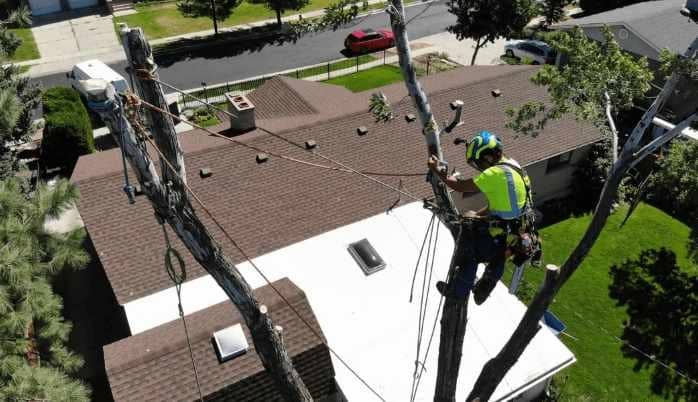
In 2025, most homeowners will pay $300 to $900 per tree to trim, with a national range of $150 to $2,000+ depending on height, access, risk, cleanup, and local demand.
This guide explains what drives the price (tree size, species, obstacles, power lines), what’s usually included, and which add-ons cost extra (cranes, traffic control, heavy log hauling). You’ll also see easy ways to save: schedule in the off-season, bundle multiple trees, or choose “chip brush, leave logs.” Use our checklist to get 2 to 3 written, line-item quotes with proof of insurance so you can compare apples to apples and pay a fair price without risking safety or tree health.
Average Tree Trimming Cost in 2025
Typical range (most homes): $300-$900 per tree
Overall range: $150-$2,000+ per tree
- Small ornamental trims can be as low as $150-$350.
- Mid-size shade trees usually land $400-$800.
- Large or risky trees often run $900-$2,000+ especially if climbing, rigging, or traffic control is required.
- Multi-tree discounts are common. If you have 3-5 trees, ask for bundle pricing.
Why the wide range? Tree work is a mix of height, risk, and logistics. A small crepe myrtle next to the driveway is quick. A 70-foot oak over a roof with power lines and a fenced yard isn’t.
Price by Tree Size & Type
Use these ballpark 2025 ranges to gauge whether a quote makes sense in your area. (Your local market and access can push prices up or down.)
| Tree Size / Type | Typical Height | What’s Included | 2025 Price Range (per tree) |
| Small ornamental (crape myrtle, redbud, cherry) | 10-20 ft | Light shaping, deadwood removal, basic cleanup | $150-$350 |
| Medium shade (maple, birch, fruit trees outgrown) | 20-40 ft | Crown thinning, clearance from roof, haul-off | $300-$650 |
| Large shade (oak, elm, sycamore) | 40-60 ft | Multi-point pruning, rigging over structures | $600-$1,200 |
| Very large / heritage | 60-90 ft+ | Climber crew, rigging, multi-day work | $1,200-$2,500+ |
| Pines & conifers | 30-80 ft | Height-focused trimming, ladder/climb | $400-$1,400 |
| Palms (species dependent) | 15-60 ft | Frond/seed pod removal, shaping | $150-$700 |
Note on palms: Height and species matter. Washingtonia and Canary Island date palms can cost more if they’ve been neglected or need spikes/rigging.
What Changes the Price (7 Key Factors)
- Height & Canopy Spread – More height = more time, gear, and safety steps.
- Species & Wood Density – Oaks, pecans, and palms can be tougher than maples or birch.
- Access & Drop Zone – Can the chipper park near the tree? Are there fences, pools, decks, or tight gates?
- Structures & Utilities – Work over roofs, sheds, glass, or near power lines needs extra protection and sometimes a utility coordination.
- Health & Neglect – Storm damage or years without pruning increases risk and cleanup volume.
- Debris & Cleanup Level – “Cut and leave” is cheaper; full chip/haul and lawn-safe cleanup costs more.
- Local Demand & Season – Peak storm season or busy months raise prices; off-peak dates can save you money.
Add-Ons That Raise or Lower Your Bill
- Included most of the time: Basic debris removal, minimal shaping, ground raking.
- Often extra:
- Hauling heavy wood/logs beyond standard chips.
- Traffic control for street-side trees.
- Crane rental for high-risk or tight sites.
- Power line coordination (if not handled by the utility).
- Emergency or weekend service.
- Ways to save:
- Ask for “curb-side stack” (you dispose later).
- Request chip-only (logs left for firewood).
- Bundle multiple trees in one visit.
DIY vs. Hiring a Pro
DIY makes sense for small, low trees with clear drop zones and no utilities nearby. You’ll still need: sharp hand saws, loppers, PPE (gloves, eye/ear protection), and a safe plan for limb direction.
Hire a pro when any of this is true:
- Over 20-25 feet, close to power lines, or over roofs/vehicles
- Rot, storm splits, or limbs under tension
- You need proper pruning cuts to protect tree health (bad cuts = future damage)
- Insurance/liability matters (worker injuries or property damage can be costly)
Bottom line: For anything beyond basic ground-level shaping, professional crews with insurance and trained climbers are worth it.
How to Get a Fair Quote (Checklist)
Use this copy-and-paste list when you call or message arborists:
- Describe the goal: “Reduce weight over roof,” “increase sunlight,” or “clear 8 ft over the driveway.”
- Provide photos: Front, side, base flare, and any nearby obstacles.
- Ask for a written line-item quote that states:
- Scope per tree (which limbs/areas)
- Cleanup level (chip, haul, log removal)
- Protection steps (roof, lawn, garden beds)
- Equipment (bucket truck, climber, crane)
- Proof of insurance (liability + workers’ comp)
- Estimated start date and duration
- Price per tree + total with taxes/fees
- Get 2-3 comparable quotes the same week so demand doesn’t skew results.
- Confirm who handles permits/utility coordination if needed.
Ways to Save Without Risk
- Trim in the off-season. Late fall to winter (outside storm response) often has lower rates.
- Bundle work. Group neighbors or several of your trees; ask for a multi-tree discount.
- Clarify cleanup. “Chip brush, leave logs” can cut costs if you can handle logs later.
- Mark access paths. Clear gates, move vehicles, and protect sprinklers to reduce crew time.
- Set a realistic scope. “Health prune and roof clearance” costs less than full aesthetic reshaping.
Sample Quotes (Realistic Scenarios)
These are example breakdowns so you can compare apples to apples.
Scenario A: Small ornamental by driveway (15 ft)
- Scope: Shape canopy, remove crossing limbs, 1 hr chip/haul
- Crew: 2 techs + chipper
- Time: ~1.5-2 hrs
- Estimated 2025 price: $200-$300
Scenario B: Medium maple near roof (30 ft)
- Scope: Raise canopy to 8 ft, thin 15%, clear 6-8 ft from roof line
- Crew: Climber + grounds, chip/haul
- Time: ~3-4 hrs
- Estimated 2025 price: $450-$700
Scenario C: Large oak over deck (55 ft), tight access
- Scope: Rigging over structure, selective weight reduction, debris haul
- Crew: 3-4 techs, climber; possible mini-skid
- Time: 1 day
- Estimated 2025 price: $950-$1,600
Scenario D: Very large pine street-side (70 ft) with traffic control
- Scope: Height reduction (selective), deadwood, DOT cones/flagging
- Crew: 4 techs, bucket truck, chipper
- Time: 1 day
- Estimated 2025 price: $1,400-$2,200
Timing, Permits, and HOA Rules
- Season: Many cities allow trimming year-round but prefer late fall/winter for tree health and nesting protection.
- Permits: Some municipalities require permits for heritage trees, specific species, or trees above certain trunk diameters. Check your city website before scheduling.
- HOA approvals: If your neighborhood has landscaping guidelines, send your scope and arborist’s plan for fast approval.
- Utility lines: For primary power, your utility may handle or require clearance work, ask before you pay twice.
Final Takeaway
You don’t need to guess at tree trimming prices in 2025. Start with the ranges above, use the quote checklist, and compare 2 to 3 written, line-item estimates from insured pros. Focus on safety, tree health, and a clear scope, and you’ll pay a fair price while protecting your home and landscape.
FAQs
What is the average cost to trim a tree in 2025?
Most homeowners pay $300-$900 per tree. Small ornamentals can be $150-$350; large, risky trees can exceed $1,500.
Is pricing per hour or per tree?
Residential quotes are usually per tree based on difficulty, crew size, and cleanup. Hourly pricing appears for “time and materials” jobs or storm work.
How often should I trim trees?
Typically, every 2-4 years for general health and clearance. Fast-growing species and storm-damaged trees may need more frequent attention.
Does trimming hurt the tree?
Proper pruning helps tree health. Problems arise from over-pruning or flush cuts. Ask for ANSI-A300 pruning standards and a certified arborist when possible.
Can I save money by leaving debris on site?
Yes. “Chip brush, leave logs” or “curb-side stack” can trim costs, especially on big trees.
When is the cheapest time to trim?
Often late fall through winter (outside storms). Crews are less booked, and foliage is thinner for easier work
What insurance should a tree company have?
Ask for general liability and workers’ compensation. Request COI (Certificate of Insurance) sent to you directly from the insurer.
What if branches are near the power line?
Do not handle this yourself. Contact your utility or use a pro who coordinates with them. Prices reflect the added safety steps.
Will a permit be required?
Some cities require permits for protected or heritage trees. Always check local code or your city’s forestry department.
Why are palm trees priced differently?
Species, height, and neglected fronds/seed pods drive time and risk. Tall palms often need climbers and spikes, raising cost